
Belt conveyor
Aston Belt Conveyor: Efficient Inline Material Transport & Transfer
To streamline continuous bulk material transport, the Aston mining belt conveyor leverages a friction-driven mechanism to move materials efficiently along the processing line. Operating smoothly across various inclination angles, the durable belt system carries loose bulk solids and bagged goods, ensuring steady flow rates in coal processing, quarrying, and aggregate distribution.
The structural framework incorporates heavy-duty idlers and a reinforced steel truss, providing high tensile support with minimal belt wear. By maintaining optimal belt tension and precise tracking under continuous load, the conveyor handles powdery, granular, and low-abrasive materials without spillage or operational interruptions.
Built for seamless integration across crushing and screening circuits, this conveying system serves as a key connecting link in bulk handling operations. The accessible component design simplifies idler inspections and belt splicing, helping mine operators cut maintenance downtime and maintain continuous plant throughput.
Tape width: 400~2400mm
Conveying speed: 1~2m/s
Capacity: 30~3000t/h
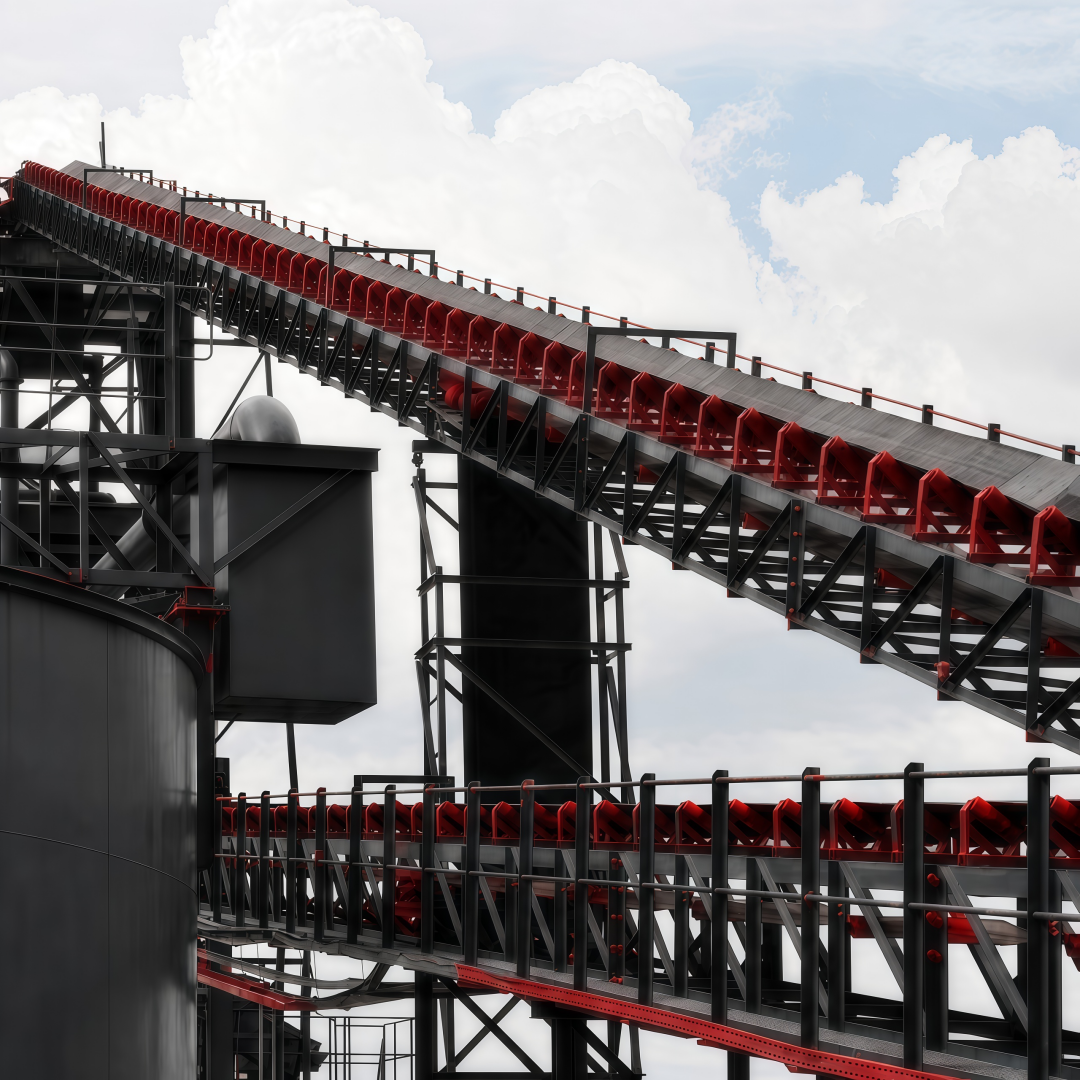
Application field of belt conveyor
Material
Optimized for handling unprocessed ore, crushed stone, coal, sand, and various mineral aggregates with bulk densities below 1.67 t/m³. Operating reliably under heavy loading conditions, the system easily transports powdery, granular, and small-to-medium lump feeds between processing units, ensuring steady material flow through every crushing stage with minimal spillage.
Application
Specifically configured for primary, secondary, and tertiary stages within crushing and screening circuits. It acts as the key conveying bridge in mining plants, aggregate quarrying operations, and concrete mixing station feed lines—delivering seamless inter-stage transfers, closed-circuit recirculation, and continuous finished-product stockpiling.
Belt conveyor features:
- Optimized friction drive & Precision tracking assembly: Incorporating high-traction drive pulleys and precision-aligned idler sets, the transmission minimizes belt slippage and energy loss, ensuring smooth, non-stop material flow even under peak operating loads.
- Modular truss frame & Scalable sectional design: Built with standardized, interchangeable frame sections, the conveyor length can be precisely configured to match specific site dimensions, allowing straightforward extension or relocation as production needs evolve.
- Compact steel chassis with adjustable inclination: Designed with a space-saving profile and adaptable elevation angles, the unit fits seamlessly into tight plant layouts, establishing direct transfer links between crushers, screens, and discharge hoppers.
- Versatile horizontal & Inclined layout module: Allows flexible combination as a standalone unit or within multi-conveyor systems, adaptable to varying site terrains for seamless line integration.
- All-weather thermal protection design: Operates reliably in ambient temperatures from -20°C to +40°C, efficiently moving bulk materials at temperatures below 50°C without belt degradation.
Specification of belt conveyor:
| Tape width (mm) | Conveying length (m) | Conveying speed (m/s) | Conveying capacity (t/h) | ||
| Power (kw) | |||||
| 400 | ≤10 | 12-15 | 15-30 | 1.25-2.0 | 30-60 |
| 3 | 3-4 | 4-7.5 | |||
| 500 | ≤10 | 12-15 | 15-30 | 1.25-2.0 | 40-80 |
| 3 | 4-5.5 | 5.5-7.5 | |||
| 650 | ≤10 | 12-15 | 15-30 | 1.25-2.0 | 80-120 |
| 4 | 7.5 | 7.5-11 | |||
| 800 | ≤10 | 12-15 | 15-30 | 1.25-2.0 | 120-200 |
| 4 | 7.5 | 7.5-15 | |||
| 1000 | ≤10 | 10-20 | 20-40 | 1.25-2.0 | 200-320 |
| 5.5 | 7.5-11 | 11-22 | |||
| 1200 | ≤10 | 10-20 | 20-40 | 1.25-2.0 | 290-480 |
| 7.5 | 7.5-15 | 15-30 | |||
| 1400 | ≤10 | 10-20 | 20-40 | 1.25-2.0 | 400-680 |
| 11 | 15-22 | 22-45 | |||
| 1600 | ≤10 | 10-20 | 20-50 | 1.25-2.0 | 600-1080 |
| 15 | 22-30 | 30-75 | |||
| 1800 | ≤10 | 10-20 | 20-50 | 1.0-2.0 | 800-1500 |
| 18.5 | 30-45 | 45-110 | |||
| 2000 | ≤10 | 10-20 | 20-50 | 1.0-2.0 | 1000-2000 |
| 22 | 45-55 | 55-132 | |||
| 2400 | ≤10 | 10-20 | 20-50 | 1.0-2.0 | 1500-3000 |
| 30 | 55-75 | 75-185 | |||
Applicable materials for belt conveyor

Dolomite

Sand stone

Limestone

Marble

Pebbles

Basalt

Recycled concrete

Coal gangue
Phosphate rock

Gypsum

Granite

Shale
Versatile applications for belt conveyor
Mining belt conveyors act as the central arterial backbone within ore extraction and aggregate processing facilities. By maintaining a continuous, automated material link between processing stages, this equipment prevents operational bottlenecks, minimizes manual handling risks, and optimizes overall plant throughput.
Typical application areas
Mining & Mineral extraction lines:
The conveying system handles mined deposits such as copper, gold, and iron ores. Positioned between primary crushing stations and surge bins, it delivers steady high-capacity transport to downstream grinding mills and concentration circuits.
Quarrying & Aggregate production:
It transfers shot rock, crushed limestone, granite, and gravel across multi-stage crushing circuits. The adaptable incline configuration seamlessly routes sized fractions between vibrating screens, secondary crushers, and final stockpiles.
Coal preparation & Washing plants:
Configured for bulk coal handling, the conveyor moves run-of-mine coal and washed fractions smoothly. Its enclosed transfer design reduces material loss and prevents spillage during continuous feed to boilers or railcar loading silos.
Explore industrial applicationsWorking process of belt conveyor
The Aston belt conveyor operates through a friction-driven mechanism powered by a high-efficiency motorized pulley system. As the electric motor drives the primary drum, the continuous rubber belt moves smoothly along the carrying idlers, transporting bulk materials at a steady velocity toward the discharge terminal for automatic gravity unloading.
Bulk minerals or crushed aggregates are loaded onto the feed tail through hoppers or upstream equipment, where impact idlers absorb shock and center the load.
The electric motor drives the primary pulley, utilizing surface friction between the drum and the belt to initiate smooth, non-slip belt motion along the frame.
The forced circular motion continuously lifts particles off the deck surface and tosses them forward. This dynamic force causes finer particles to sink through bed voids toward the mesh, while coarser pieces remain on the top layer.
Upon reaching the head pulley, the conveyed material falls naturally under gravity into bins or downstream conveyors, completing a continuous material handling cycle.
Belt conveyor main components
Engineered with high-strength structural steel and standardized interchangeable parts, each component of the Aston belt conveyor is precision-crafted for continuous bulk handling performance. The streamlined design combines large conveying capacities with low maintenance demands, ensuring reliable operational stability across diverse mining and aggregate layouts.
Designed for smooth material flow, the wear-resistant rubber belt is supported by precision troughing idlers that minimize friction and optimize load capacity.
Provides high-torque friction transmission to drive the belt efficiently at constant speeds, keeping energy consumption low during heavy-load transport.
Built with uniform structural sections, the durable frame allows straightforward assembly, convenient routine inspections, and swift component replacement.