
Jaw Crushers
Crush Hard Rock Efficiently with ASTON Jaw Crushers
Available in stationary and mobile configurations for primary crushing of hard and abrasive materials.
Power through granite, basalt, limestone, and concrete with ASTON high-performance jaw crushers. Engineered for reliability, high reduction ratios, and continuous heavy-duty operation, our jaw crushers deliver consistent output while minimizing downtime and operating costs.
Whether you need a stationary primary crushing solution or a mobile unit for flexible site deployment, ASTON jaw crushers are built to maximize productivity at every stage of your aggregate, mining, or recycling project.
High throughput. Rugged design. Lower cost per ton.
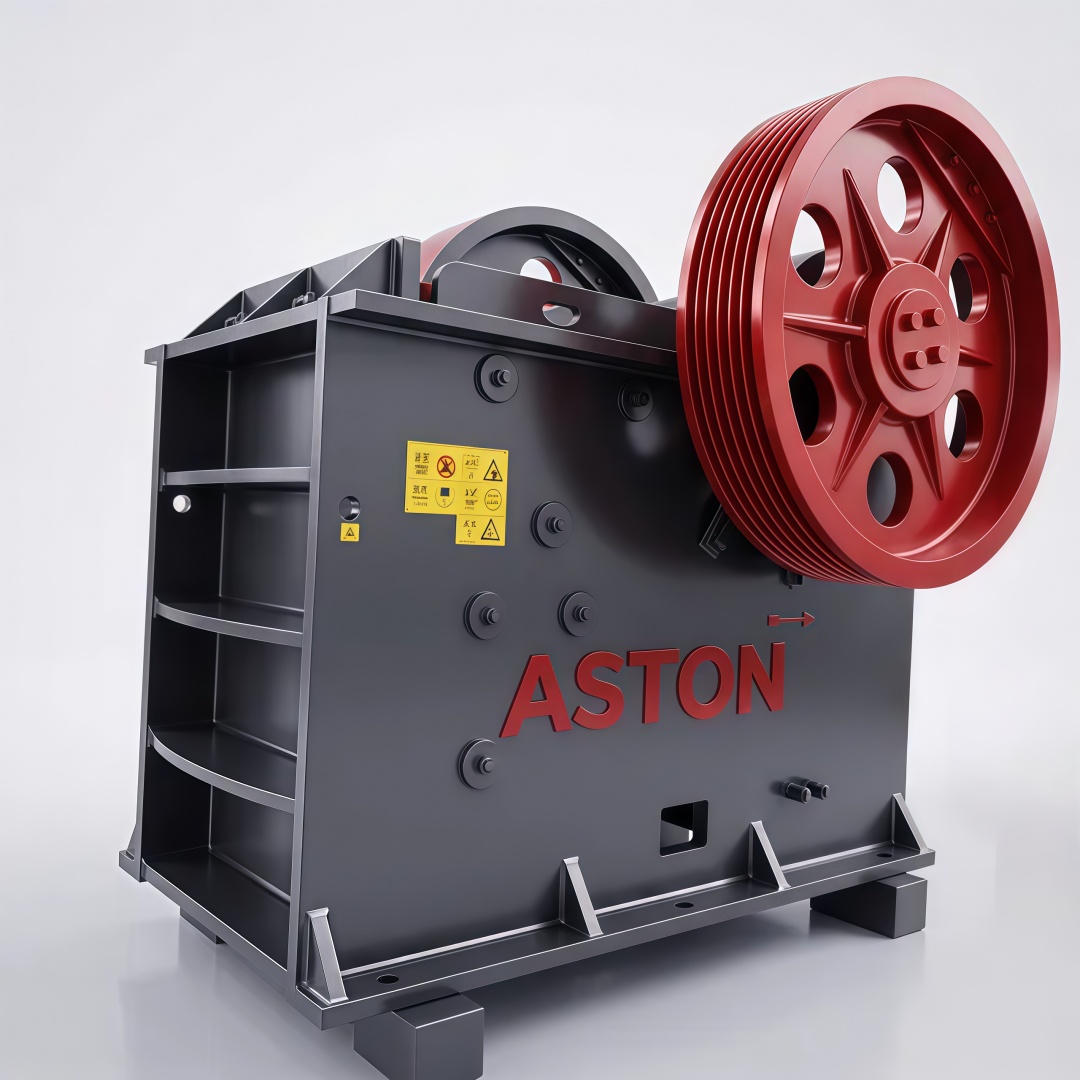
Exlpore our jaw crusher solutions

Stationary jaw crusher
SCV series / PE series
Capacity range: 10-1200t/h

Mobile jaw crusher
Wheel type / Crawler type
Capacity range: 45-500t/h
Materials processed by jaw crushers
For primary crushing / hard & abrasive materials

Basalt

Granite

Limestone

Marble

Pebble

Quartz

Copper ore

Gold ore

Iron ore

Lead zinc ore

Molybdenum ore

Nickel ore
Key benefits of Aston jaw crusher for sale

High crushing efficiency for hard rock
Designed for primary crushing, ASTON jaw crushers process granite, basalt, limestone, and concrete with high reduction ratios and stable output — ideal for both stationary plants and mobile applications.
Rugged structure, long service Life
Heavy-duty frames, reinforced bearings, and wear-resistant jaw plates ensure reliable operation under continuous high-load conditions, reducing downtime and maintenance costs.
Available in stationary and mobile configurations
Choose a standalone jaw crusher for fixed crushing lines or a mobile jaw crusher for flexible on-site operation. Both options are engineered for easy installation and consistent performance.
Aston jaw crusher for sale
ASTON offers a complete range of jaw crushers for primary crushing applications, including stationary jaw crushers and mobile jaw crushers. Designed for processing hard and abrasive materials, our jaw crushers deliver reliable performance in mining, quarrying, and aggregate production projects.
Stationary jaw crusher
SC series jaw crusher
Feeding size: ≤2000mm
Finished products size: 40-300mm
Capacity: 65-1460t/h
The SC Series jaw crusher is designed for heavy-duty primary crushing with high output and long service life. Featuring a robust welded frame structure and advanced crushing chamber design, it delivers high reduction ratios and consistent product size.
Key Features:
- Reinforced steel frame for maximum structural stability
- Optimized chamber geometry for higher throughput
- Heavy-duty bearings and durable wear parts
- Suitable for granite, basalt, iron ore, and other hard rock materials
Application fields: Widely used in large-scale mining operations and aggregate production lines requiring continuous high-capacity crushing.
Specifications of SC series jaw crusher
| Model | Feeding size (mm) | Maximum feed (mm) | Power (kw) | Outlet size (mm) | Capacity (t/h) |
| SC80 | 800×510 | 420 | 75 | 40-175 | 65-365 |
| SC96 | 930×580 | 480 | 90 | 60-175 | 120-410 |
| SC100 | 1000×760 | 600 | 110 | 70-200 | 140-510 |
| SC106 | 1060×700 | 600 | 110 | 70-200 | 165-520 |
| SC110 | 1100×850 | 750 | 160 | 70-200 | 180-540 |
| SC116 | 1150×760 | 700 | 132 | 70-200 | 190-625 |
| SC120 | 1200×870 | 800 | 160 | 70-175 | 190-560 |
| SC125 | 1250×950 | 850 | 185 | 100-250 | 260-775 |
| SC130 | 1300×1000 | 900 | 185 | 100-250 | 285-850 |
| SC140 | 1400×1070 | 950 | 200 | 125-250 | 345-870 |
| SC150 | 1400×1200 | 1000 | 220 | 125-250 | 355-900 |
| SC160 | 1600×1200 | 1000 | 250 | 150-300 | 445-1170 |
| SC200 | 2000×1500 | 1200 | 400 | 175-300 | 645-1460 |

PE series jaw crusher
Feeding size: ≤1200mm
Finished products size: 15-225mm
Capacity: 1-1200t/h
The PE Series jaw crusher is a classic and cost-effective solution for primary crushing. With a simple structure and reliable mechanical design, it is suitable for medium-scale crushing plants and various construction material applications.
Key Features:
- Proven design with stable performance
- Easy maintenance and simple operation
- Wide model range to match different capacity needs
- Suitable for limestone, river stone, construction waste, and more
Application fields: Commonly used in quarrying, road construction, concrete recycling, and medium-sized crushing lines.
Specifications of PE series jaw crusher
| Model | Feeding size (mm) | Discharge size (mm) | Processing capacity (t/h) | Motor power (kw) | Overall dimension (mm) |
| PE150×250 | ≤130 | 15–45 | 1–4 | 5.5 | 896×745×935 |
| PE250×300 | ≤150 | 15–55 | 3–6 | 7.5 | 1050×987×1000 |
| PE250×400 | ≤210 | 25–60 | 5–20 | 15 | 1215×1520×1030 |
| PE400×600 | ≤350 | 40–90 | 15–60 | 30 | 1650×1588×1050 |
| PE500×750 | ≤425 | 50–100 | 40–110 | 45 | 1956×1918×1920 |
| PE600×900 | ≤500 | 60–125 | 90–180 | 55 | 2250×2733×2280 |
| PE800×900 | ≤600 | 80–140 | 100–220 | 75 | 2450×2950×2490 |
| PE750×1060 | ≤630 | 60–150 | 110–380 | 110 | 2531×2455×2783 |
| PE900×1060 | ≤700 | 100–160 | 230–390 | 110 | 2900×2657×2950 |
| PE900×1200 | ≤750 | 110–165 | 220–450 | 132 | 3100×2760×3260 |
| PE1000×1200 | ≤900 | 110–185 | 315–500 | 132 | 3200×2760×3260 |
| PE1200×1500 | ≤950 | 115–195 | 550–1000 | 220 | 3710×3446×4075 |
| PE1500×1800 | ≤1200 | 135–225 | 600–1200 | 280 | 5100×4700×4300 |
| PEX150×750 | ≤120 | 10–40 | 8–25 | 15 | 1310×1118×1145 |
| PEX250×750 | ≤210 | 15–50 | 15–35 | 22 | 1400×1751×1515 |
| PEX250×1000 | ≤210 | 15–60 | 15–60 | 30 | 1550×1964×1380 |
| PEX250×1200 | ≤210 | 15–60 | 20–60 | 37 | 1530×1946×1380 |
| PEX300×1300 | ≤250 | 25–60 | 16–105 | 55–75 | 2000×2320×1730 |
Stationary jaw crusher on-site operation:


Mobile jaw crusher
Mobile wheel type jaw crusher
Feeding size: ≤740mm
Finished products size: 40-250mm
Capacity: 45-500t/h
The wheel-type mobile jaw crusher is mounted on a road-towable chassis, allowing easy transportation between sites. It integrates feeding, primary crushing, and conveying systems into a compact and modular structure.
Key Features:
- Road-transportable chassis for fast relocation
- Integrated feeder, jaw crusher, and discharge conveyor
- Reduced installation time and lower civil costs
- Capacity range suitable for small to medium projects
Application fields: Ideal for highway construction, urban infrastructure projects, and temporary crushing operations requiring mobility.
Specification of Mobile wheel type jaw crushers
| Model | Device configuration | Adjustable range Of discharge opening(mm) | Capacity(t/h) | Transport dimension(mm) |
| AS15L | ZSW3896+LF150 | 40-100 | 100-200 | 13050X2950X3100 |
| AS25L | ZSW4211+LF250 | 50-120 | 200-400 | 12750X3000X3700 |
| AS35L | ZSW4213+LF350 | 50-200 | 300-500 | 14360X3000X3800 |
| AS69L | ZSW3896+PE69 | 60-125 | 100-180 | 12500X2950X3000 |
| AS96L | ZSW3896+SC96 | 60-175 | 120-455 | 13500X3400X2800 |
| AS106L | ZSW4211+SC106 | 70-200 | 155-580 | 14400X3600X3000 |
| AS110L | ZSW1349+SC110 | 70-250 | 190-625 | 18470X6840X4700 |
Mobile crawler jaw crusher
Feeding size: ≤400mm
Finished products size: 18-40mm
Capacity: 100-500t/h
The crawler-type mobile jaw crusher features a track-mounted chassis for superior maneuverability on rough terrain. It is designed for demanding mining and quarry applications where stability and high output are required.
Key Features:
- Track-mounted system for off-road flexibility
- Remote-controlled movement and positioning
- Heavy-duty jaw crusher integrated for hard rock processing
- Suitable for large-scale and high-capacity operations
Application fields: Widely used in mining sites, quarry operations, and projects requiring frequent repositioning within the site.

Specification of mobile crawler type jaw crushers
| Model | Device configuration | Adjustable range Of discharge opening(mm) | Capacity(t/h) | Transport dimension(mm) |
| AS15L | ZSW3896+LF150 | 40-100 | 100-200 | 13050X2950X3100 |
| AS25L | ZSW4211+LF250 | 50-120 | 200-400 | 12750X3000X3700 |
| AS35L | ZSW4213+LF350 | 50-200 | 300-500 | 14360X3000X3800 |
| AS69L | ZSW3896+PE69 | 60-125 | 100-180 | 12500X2950X3000 |
| AS96L | ZSW3896+SC96 | 60-175 | 120-455 | 13500X3400X2800 |
| AS106L | ZSW4211+SC106 | 70-200 | 155-580 | 14400X3600X3000 |
| AS110L | ZSW1349+SC110 | 70-250 | 190-625 | 18470X6840X4700 |
Mobile jaw crushing plant on-site operation:


Compare stationary and mobile jaw crushers
Stationary jaw crusher
Mobile jaw crusher
Installation method
Fixed installation on concrete foundation within a crushing plant.
Mounted on wheel-type or crawler-type chassis for mobility.
Mobility
Designed for long-term, fixed-site operation.
Easily relocated between job sites or within the same site.
Site requirements
Requires prepared foundation and stable layout.
Minimal civil work; suitable for temporary or changing locations.
Production stability
Ideal for continuous, high-capacity production lines.
Designed for flexible and on-demand crushing tasks.
Typical applications
Large quarries, mining plants, aggregate production lines.
Road construction, demolition recycling, urban infrastructure projects.
Materials processed
Hard rock, granite, basalt, limestone, iron ore.
Hard rock, construction waste, mixed aggregates.
Initial investment
Lower equipment cost but requires civil construction.
Higher equipment cost but reduced foundation expenses.
Best for
Permanent crushing operations.
Projects requiring mobility and fast deployment.
Compare stationary and mobile jaw crushers
Stationary jaw crusher

Installation method
Fixed installation on concrete foundation within a crushing plant.
Mobility
Designed for long-term, fixed-site operation.
Site requirements
Requires prepared foundation and stable layout.
Production stability
Ideal for continuous, high-capacity production lines.
Typical applications
Large quarries, mining plants, aggregate production lines.
Materials processed
Hard rock, granite, basalt, limestone, iron ore.
Initial investment
Lower equipment cost but requires civil construction.
Best for
Permanent crushing operations.
Mobile jaw crusher

Installation method
Mounted on wheel-type or crawler-type chassis for mobility.
Mobility
Easily relocated between job sites or within the same site.
Site requirements
Minimal civil work; suitable for temporary or changing locations.
Production stability
Designed for flexible and on-demand crushing tasks.
Typical applications
Road construction, demolition recycling, urban infrastructure projects.
Materials processed
Hard rock, construction waste, mixed aggregates.
Initial investment
Higher equipment cost but reduced foundation expenses.
Best for
Projects requiring mobility and fast deployment.
Jaw crusher machine features:
- Heavy-duty crushing structure: Built with reinforced frames and precision-machined components, ASTON jaw crushers are designed to withstand continuous high-load primary crushing operations.
- Optimized crushing chamber design: The carefully engineered chamber geometry improves material flow and ensures efficient size reduction when processing hard and abrasive materials.
- High-strength wear components: Jaw plates and key wear parts are manufactured from durable, wear-resistant materials to support long service life under demanding working conditions.
- Flexible configuration options: Available as standalone units for stationary crushing plants or integrated into wheel-type and crawler-type mobile crushing systems to meet different project requirements.
- Reliable control and safety systems: Equipped with user-friendly control systems and essential safety protections to ensure stable operation and easy monitoring during production.
Jaw crusher price
Jaw crusher prices vary depending on type, capacity, and configuration. Below is a general price reference based on common project scales.
| Jaw crusher type | Typical capacity | Estimated price range (USD) |
|---|---|---|
| Small stationary jaw crusher | 1–20 TPH | $3,000 – $15,000 |
| Medium stationary jaw crusher | 20–100 TPH | $15,000 – $45,000 |
| Large stationary jaw crusher | 100–500 TPH | $45,000 – $120,000 |
| Mobile wheel-type jaw crusher | 50–300 TPH | $60,000 – $180,000 |
| Mobile crawler jaw crusher | 80–400 TPH | $120,000 – $350,000 |
What affects the final jaw crusher price?
The final quotation depends on:
- Required capacity (TPH).
- Maximum feed size.
- Material hardness.
- Hydraulic adjustment options.
- Stationary or mobile configuration.
Send us your material type, feed size, and target capacity — our engineers will provide a tailored quotation within 24 hours.
Versatile applications for jaw crushers
From primary crushing of hard rock in quarry and mining operations to processing recycled concrete in construction projects, ASTON jaw crushers are designed to perform reliably across a wide range of applications.
By efficiently reducing large feed sizes at the first crushing stage, jaw crushers ensure stable downstream processing and consistent aggregate quality for various industries.
Typical application areas
Mining operations:
Primary crushing of hard and abrasive ores such as granite, basalt, iron ore, and quartz.
Quarrying & aggregate production:
First-stage crushing for sand and aggregate production lines with stable, high-capacity output.
Construction & infrastructure projects:
Crushing of limestone, river stone, and construction materials for road, bridge, and urban infrastructure development.
Recycling & demolition (C&D):
Processing of concrete debris and construction waste, especially when configured as a mobile jaw crusher.
Explore industrial applicationsJaw crusher main components
ASTON jaw crushers are built around a robust and proven crushing structure. Each key component is engineered to support stable primary crushing and long-term operation in demanding environments.
The core crushing unit features a reinforced frame, precision-machined flywheels, and an optimized crushing chamber to deliver consistent reduction performance under high load.
Designed to handle large feed sizes and irregular materials, the feeding system ensures smooth material flow into the crushing chamber and reduces the risk of blockages.
Jaw plates and wear components are manufactured from high-strength, wear-resistant materials to support extended service life when processing hard and abrasive materials.
Whether installed in a stationary plant or mounted on a mobile chassis, the supporting structure provides excellent stability and vibration control during operation.
Equipped with user-friendly control systems and essential safety protections to ensure stable operation and easy monitoring during production.
What materials can our jaw crusher process?
ASTON jaw crushers are engineered for primary crushing of hard, abrasive, and high-strength materials. Whether installed as a stationary unit or integrated into a mobile crushing system, our jaw crushers deliver stable performance across a wide range of industries.
1. Hard & abrasive rocks (mining & quarrying)
Designed with wear-resistant jaw plates and reinforced crushing structures, ASTON jaw crushers efficiently process ultra-hard rock materials, including:
- Granite, Basalt, Quartz, Diabase, Andesite, and Porphyry.
These materials typically require strong primary crushing performance, making jaw crushers the preferred first-stage solution.
2. Metallic ores (mineral processing)
ASTON jaw crushers are widely used in mining operations for the primary reduction of various metallic ores:
- Iron Ore, Copper Ore, Gold Ore, Lead-Zinc Ore, Nickel Ore, and Manganese Ore.
The high compressive force of the jaw crusher ensures efficient size reduction before secondary or tertiary crushing stages.
3. Medium & soft rocks (aggregates & cement)
For aggregate production and cement raw material processing, jaw crushers provide reliable first-stage crushing of:
- Limestone, Marble, Dolomite, Sandstone, Shale, and Coal.
They ensure consistent feed size for downstream cone or impact crushers.
4. Construction & demolition (C&D) waste recycling
When configured as a mobile jaw crusher, the equipment is well-suited for on-site recycling of:
- Concrete Debris, Reinforced Concrete, Asphalt Pavement, Bricks, Blocks, and Mixed Construction Waste.
Mobile configurations enable flexible deployment in urban infrastructure and demolition projects.
5. River stones & natural aggregates
- River Pebbles, Cobblestones, Gravel, and Industrial Slag.
Jaw crushers effectively reduce these materials at the primary stage to prepare them for shaping or further processing.
Not sure if your material is suitable? Contact us with your feed size and capacity requirements for a tailored recommendation.
Want to talk? Reach out to our experts
The critical role of jaw crushers in primary crushing
In any crushing production line, the primary crushing stage determines the overall efficiency and stability of downstream processing. As the first machine to reduce large raw materials, the jaw crusher plays a decisive role in setting the foundation for the entire operation.
First stage of size reduction
Jaw crushers are specifically designed to handle large feed sizes and high compressive strength materials. By reducing oversized rocks into manageable sizes, they prepare material for secondary and tertiary crushing stages.
A properly selected jaw crusher ensures:
- Stable feed for downstream crushers
- Reduced wear on secondary equipment
- Improved overall production efficiency
- Consistent aggregate quality
Engineered for high compressive strength materials
Hard and abrasive materials such as granite, basalt, and iron ore require strong compressive force during primary reduction. The mechanical design of the jaw crusher makes it particularly suitable for these demanding applications.
Hard and abrasive materials such as granite, basalt, and iron ore require strong compressive force during primary reduction. The mechanical design of the jaw crusher makes it particularly suitable for these demanding applications.
Selecting the right jaw crusher at the primary stage is essential for long-term production performance. Our engineers can help you choose the most suitable model for your project.
Working process of jaw crusher crushing line
A jaw crusher-based crushing line follows a clear and efficient workflow designed around primary crushing. As the first stage of size reduction, the jaw crusher plays a critical role in preparing material for downstream processing, ensuring stable production and consistent final output.
Raw materials such as large rocks or concrete debris are fed into the system using an excavator, wheel loader, or vibrating feeder. The feeding system regulates material flow to ensure stable and continuous input into the jaw crusher.
The jaw crusher performs the first and most critical stage of crushing. Large feed materials are compressed between the fixed jaw and the moving jaw, reducing them to a manageable size suitable for further processing.
This stage determines:
- Overall system capacity
- Downstream equipment stability
- Wear rate of secondary crushers
After primary crushing, material may be transferred to a cone crusher or impact crusher for further size reduction, depending on the required final product size and material characteristics.
This stage refines the output and improves particle shape for aggregate applications.
Crushed material is screened into different size fractions using vibrating screens. Oversized material can be returned to the secondary crusher, while qualified material proceeds to final stockpiling.
Conveyors transport finished aggregates to designated stockpiles. The result is consistently sized material ready for use in construction, infrastructure, or industrial applications.
Engineered to maximize your profitability
Up to 30%
Optimized crushing chamber geometry and improved material flow design increase primary crushing efficiency, allowing higher processing capacity under the same operating conditions.
30% lower
Efficient mechanical motion and balanced flywheel systems reduce unnecessary vibration and power loss, improving energy utilization during continuous operation.
Extend service life
Premium wear-resistant jaw plates and reinforced structural frames significantly extend maintenance intervals, minimizing downtime and ensuring consistent production performance.
FAQs
Below are answers to some of the most common questions when selecting and operating a jaw crusher for primary crushing applications.
The right jaw crusher size depends on your maximum feed size, required capacity (tph), and material hardness. As a primary crusher, the feed opening must be large enough to accept your largest material while maintaining stable throughput.
Our engineers typically evaluate:
- Feed size and bulk density
- Desired output capacity
- Material type and abrasiveness
- Whether the crusher will be stationary or mobile
Yes, jaw crushers can process mixed-size material. However, excessive fine material in the feed may reduce crushing efficiency and increase wear.
For optimal performance:
- Use a vibrating feeder with pre-screening if fines content is high
- Maintain consistent material flow into the crushing chamber
Yes, jaw crushers can operate in a closed-circuit setup when combined with screening equipment and return conveyors. Oversized material is screened out and recirculated back into the jaw crusher for further reduction.
Closed-circuit configurations are commonly used when:
- Tighter size control is required
- Space is limited
- Consistent output grading is needed
Both stationary and mobile jaw crushing systems can be configured this way.
A jaw crusher consists of one fixed jaw and one moving jaw. Material is crushed between these two surfaces through compressive force generated by the movement of the movable jaw.
As material moves downward through the crushing chamber, it is progressively reduced in size until it exits through the discharge opening at the bottom.
This simple and robust working principle makes jaw crushers ideal for primary crushing of hard and abrasive materials.
Jaw crushers offer several advantages at the primary crushing stage:
- Ability to handle large feed sizes
- Strong compressive force for hard rock materials
- Simple structure with high reliability
- Stable output suitable for downstream crushing stages
These characteristics make jaw crushers the foundation of most crushing production lines.
Yes. Jaw crushers are widely used in both stationary crushing plants and mobile crushing systems. The core crushing structure remains the same, while installation and mobility options differ.
Stationary jaw crushers are suitable for long-term, fixed operations, while mobile jaw crushers offer flexibility for relocation and on-site crushing applications.
The choice depends on:
- Project duration
- Site conditions
- Mobility requirements
- Civil construction constraints
If your project location is fixed and long-term, a stationary jaw crusher is often more cost-effective. If frequent relocation or fast deployment is required, a mobile jaw crusher may be the better option.